The Empire State Building Proposal: AI Slop Ate the Climb
A daredevil couple scaled the world's most famous skyscraper and proposed at the top. Within hours, AI fakes and brand tie-ins had swallowed the moment whole. Look closely and it is the entire attention economy in a single frame, feeding on itself.
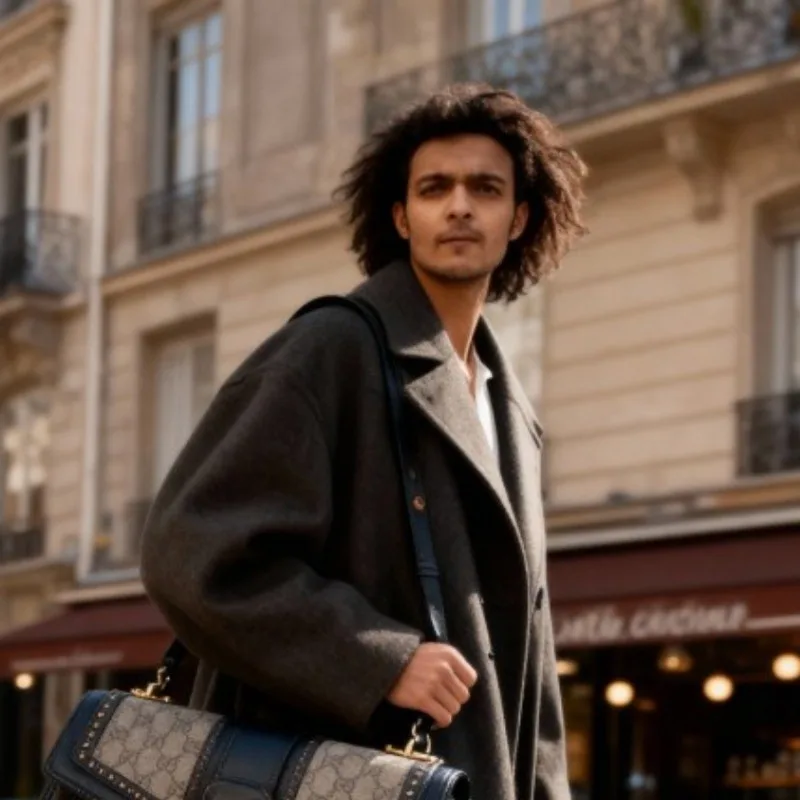
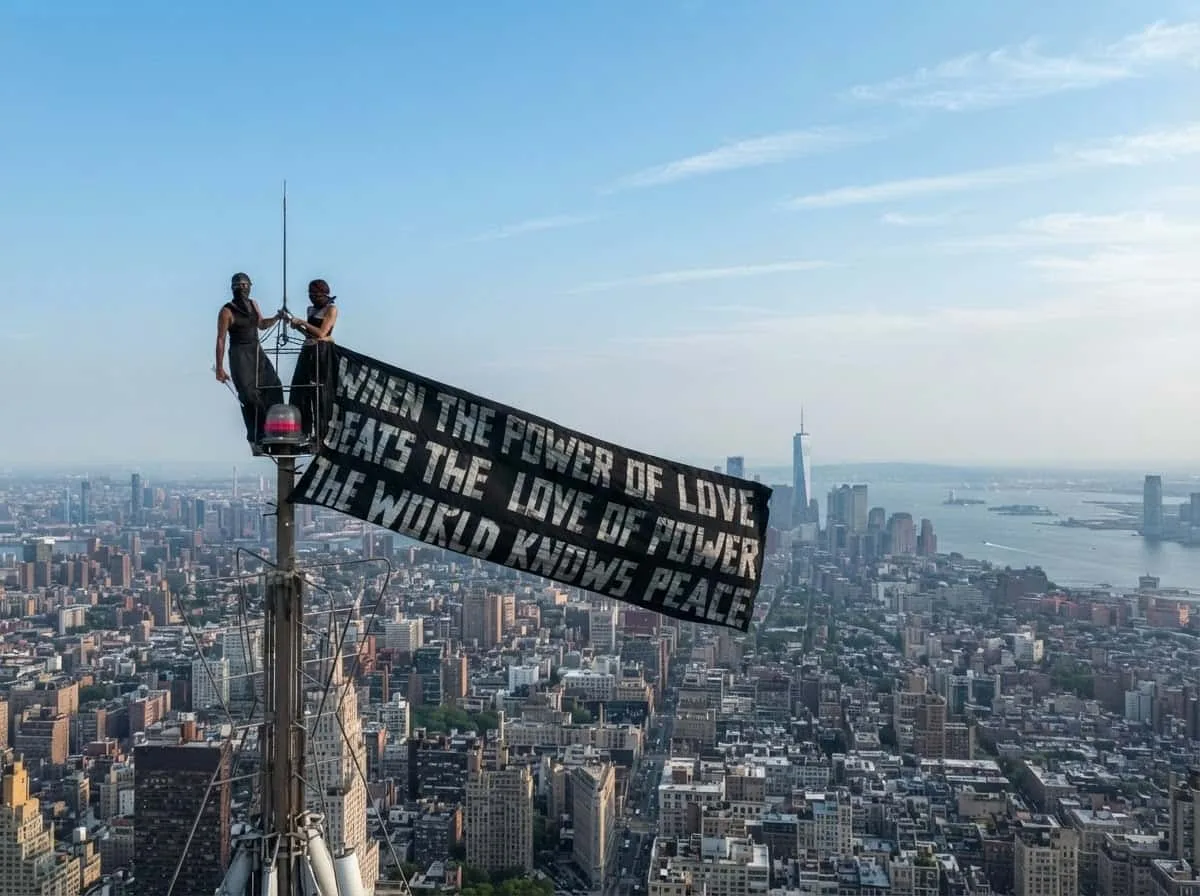
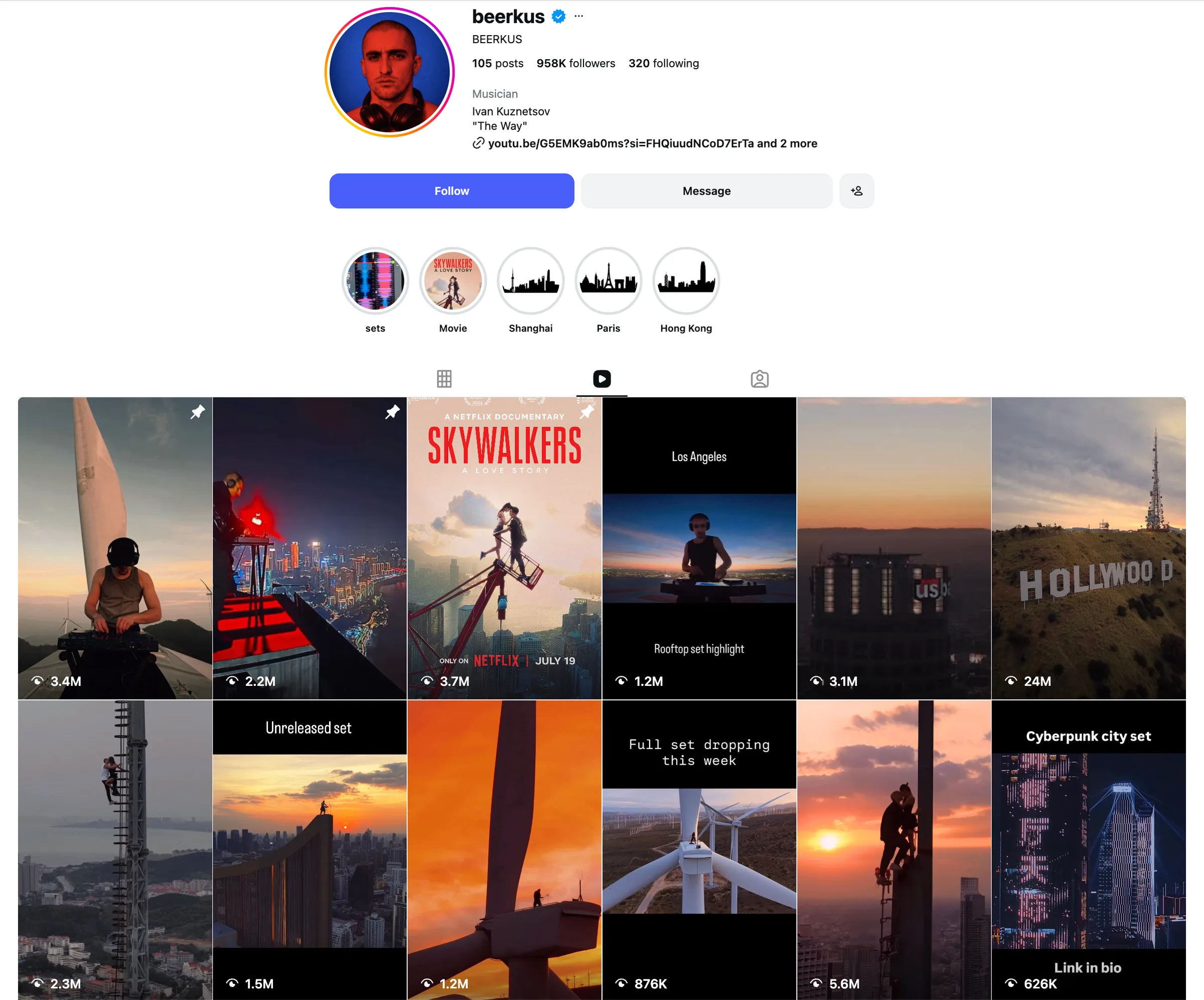
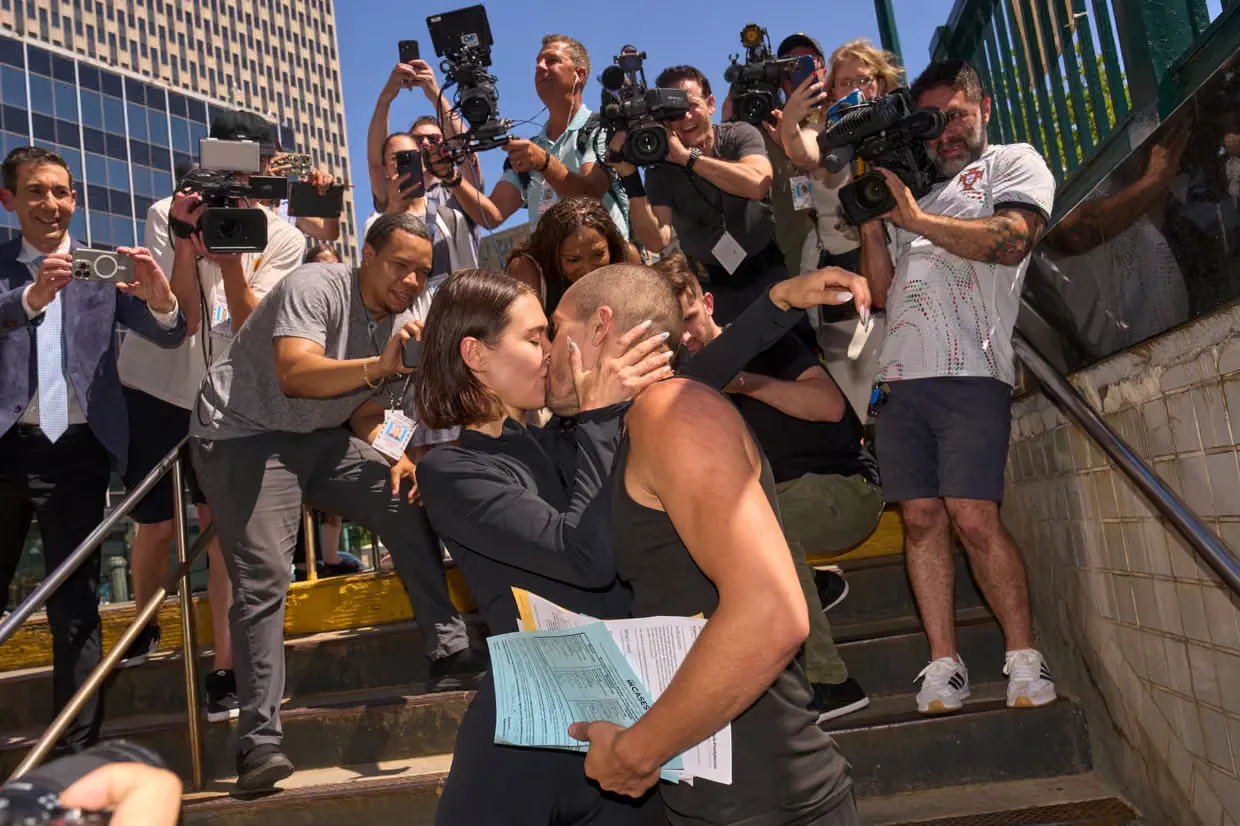
On the morning of July 1, 2026, two people stood untethered on the crown of the Empire State Building, more than 1,400 feet above Midtown, and one of them knelt. Angela Nikolau and Ivan Beerkus, the Russian rooftoppers whose romance anchored the Netflix documentary Skywalkers: A Love Story, had scaled the most famous skyscraper on earth, unfurled a black flag about the power of love, and staged a marriage proposal at an altitude where a single gust is a death sentence. It was breathtaking. It was also, on closer inspection, the entire attention economy compressed into one frame, feeding on itself. Nobody comes out of it looking good. Not the couple, not the platforms, not the brands, and if we are honest, not us either.
The climb, the flag, the arrest
Nikolau and Beerkus are professional climbers and artists who have spent years turning vertigo into content, scaling cranes and towers most people will not stand near. This time they chose an icon. They reached the antenna, flew a banner reading “When the power of love beats the love of power the world knows peace,” and Beerkus proposed at the summit. The photographs went up on Instagram and cleared 1.4 million likes inside a day.
Then the state showed up. Both were arrested and charged with reckless endangerment, burglary, criminal trespass, and possession of burglar's tools. The building's owners faced immediate questions about how anyone reached the spire at all, with at least one tourist claiming to have spotted the access point.
The Empire State Building's own social account, never one to miss a moment, trolled the couple with a cheerful list of legal proposal options down on the observation deck. The romance, in other words, arrived pre-packaged with a criminal complaint and a brand response. That should have been the first clue.
This was never really a love story
We were handed this as a fairy tale, and it is worth resisting that framing, because a fairy tale is precisely what it was engineered to be.
These are not two lovestruck amateurs who got carried away. They are performers whose entire livelihood is the monetization of risk, with a Netflix credit to prove it. The climb was a production. The banner was a slogan, tidy enough to stencil onto merchandise. The proposal was the emotional payload that guaranteed the clip would travel further than a climb alone ever could.
None of that makes the feeling between them fake. It makes the event a commodity, which is a different thing entirely. A genuinely private moment does not come with a flag, a camera angle, and a caption ready to post. What we watched was a real relationship being spent, on purpose, as fuel for reach. The love may be sincere. The love story was a deliverable.
"A genuinely private moment does not come with a flag, a camera angle, and a caption ready to post."
Then the fakes showed up
Within hours, the copies started. AI-generated videos of the same climb began circulating, synthetic clips of the couple at the summit that no camera ever shot. One account alone reportedly posted several fabricated versions on the first day. It produced a small absurdity: one of the most heavily documented real stunts in recent memory, a feat that took genuine skill and a genuine risk of death, was instantly ringed with convincing fakes of itself.
That is the quietly corrosive part. The event was real, verified, filmed, and covered around the world, and the machine still cloned it faster than anyone could label the clones.
Even the AI companies piled on
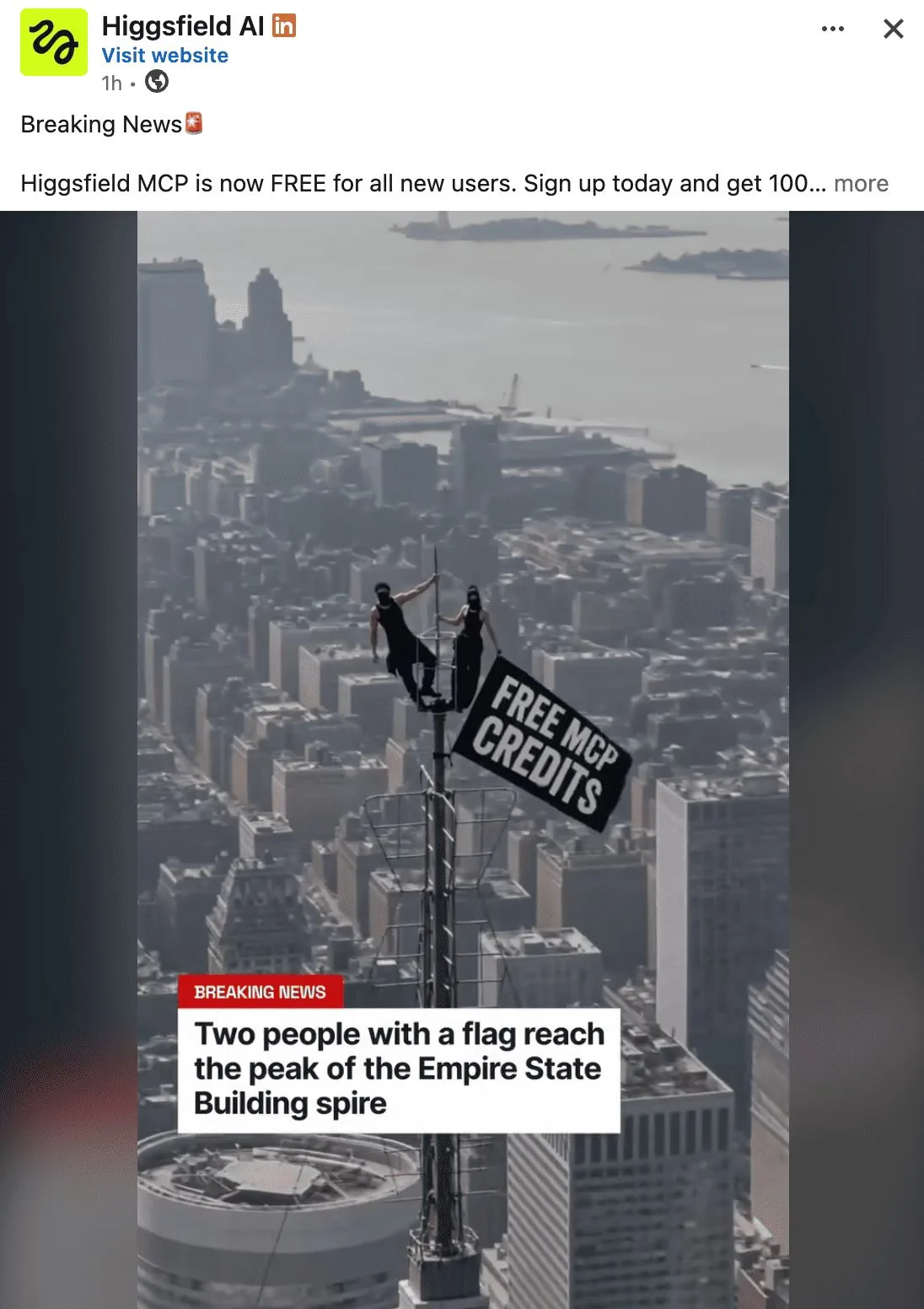
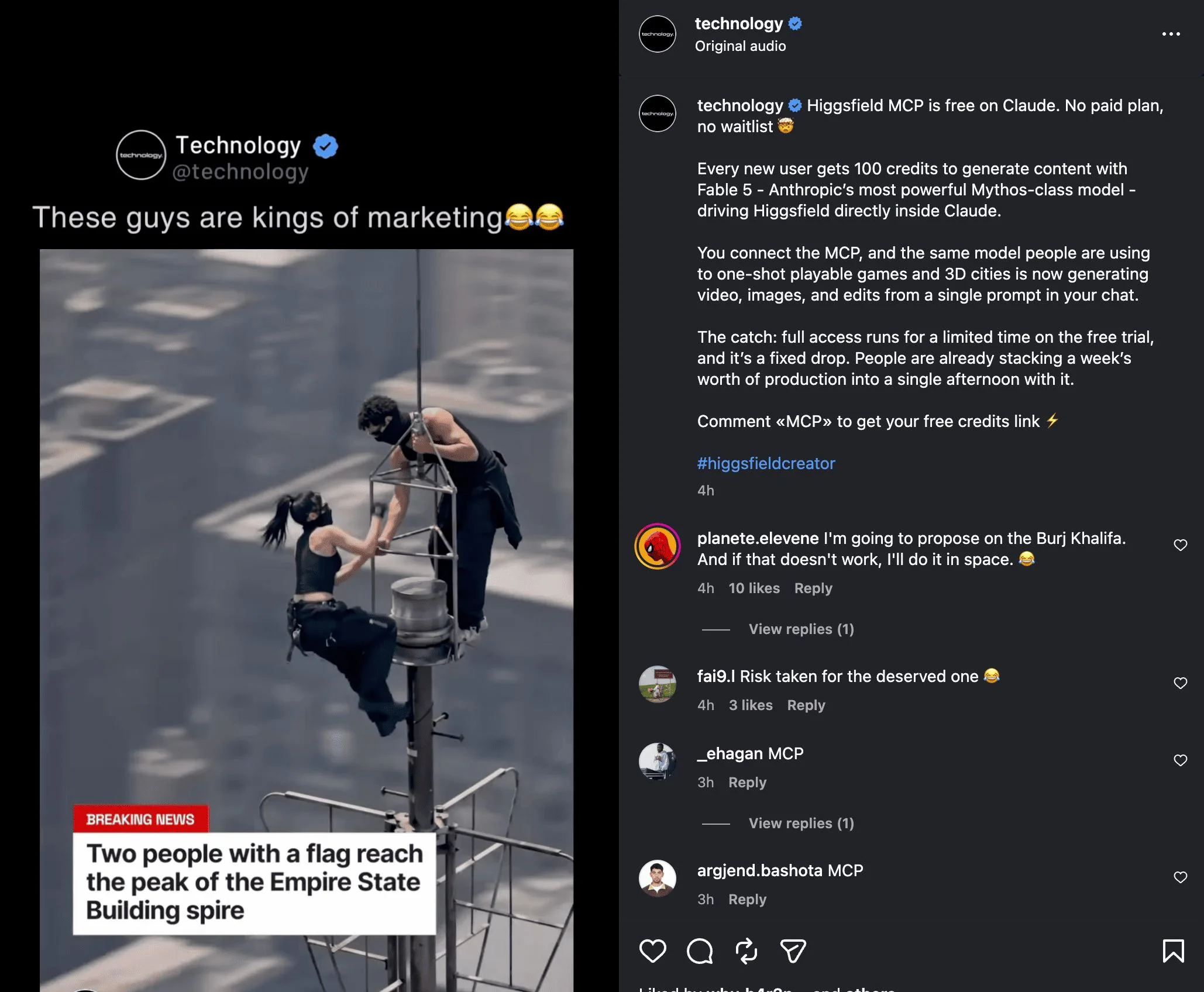
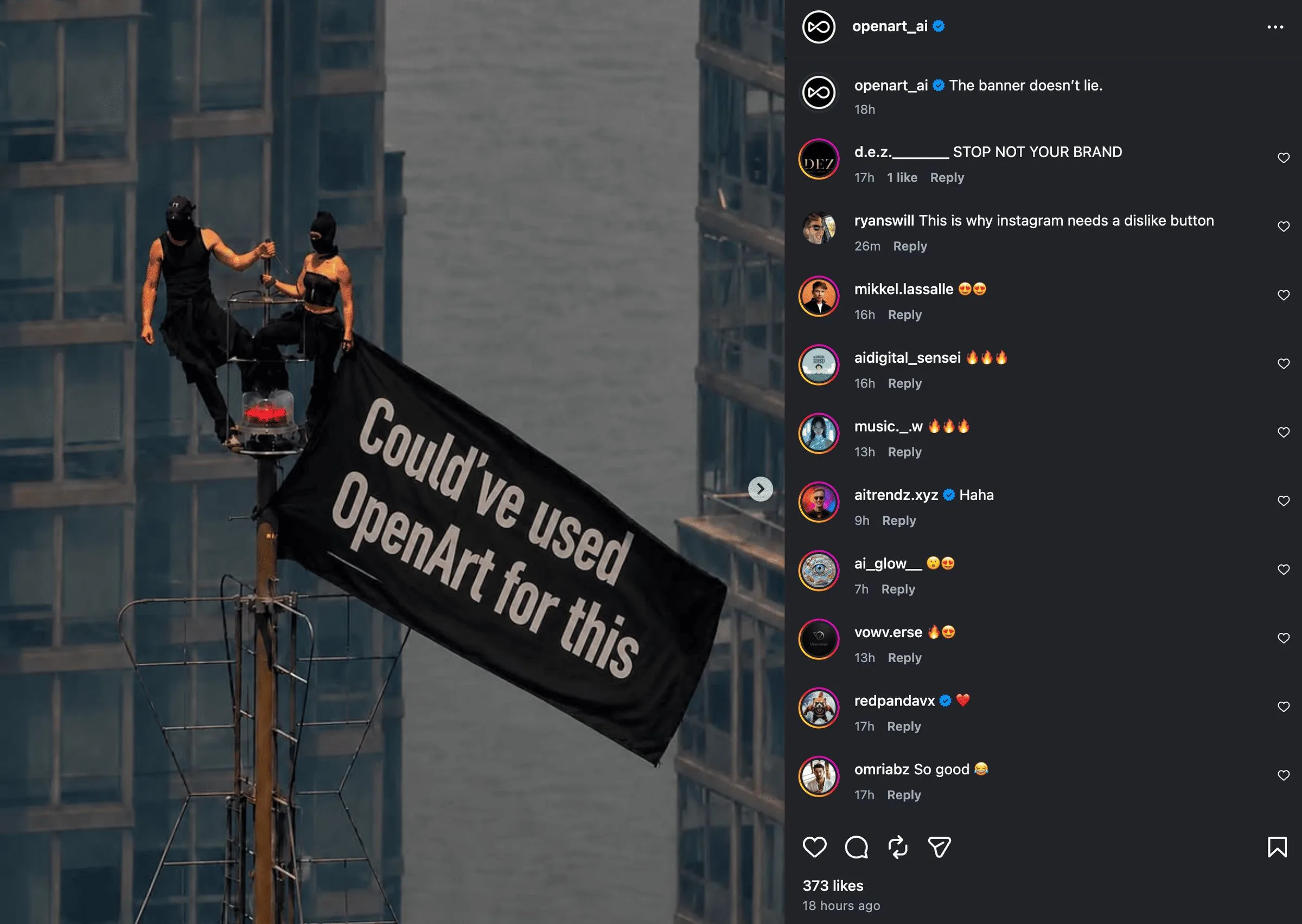
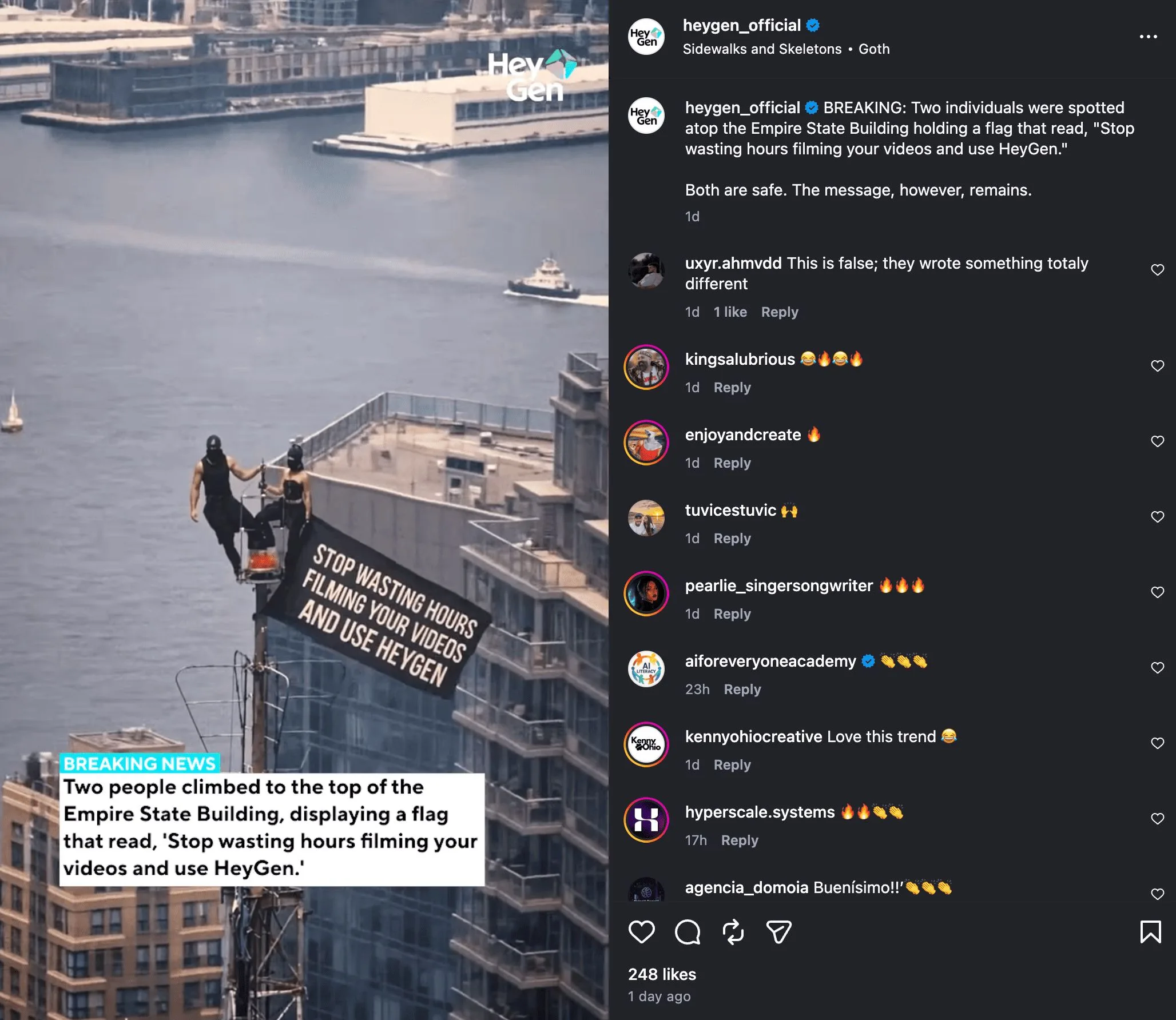
It was not only anonymous accounts and retail brands. The AI companies themselves got in on it. Higgsfield, OpenArt, and even HeyGen recreated the climb with their own models and posted the results, turning a stunt that could have ended in two deaths into a live demo of their generators. There is a particular queasiness to a generative-AI company using a near-tragedy as a product showcase.
Screenshots from Higgsfield, OpenArt & HeyGen's official accounts
The brands smelled blood
Where the fakes went, the rest of marketing followed at the same reflexive speed. Canva enlarged the couple's banner, swapped its earnest message for “Make the sign bigger with Canva,” and dropped a laptop into the proposal scene. A fashion retailer posted an AI-generated image of the pair in wedding attire to sell guest dresses. Petco, Loverboy, Spritz, and dozens of others piled in, each one bending a near-death proposal into a product pitch. Fast Company gave the pile-on the only name it deserved: brand-trend slop.
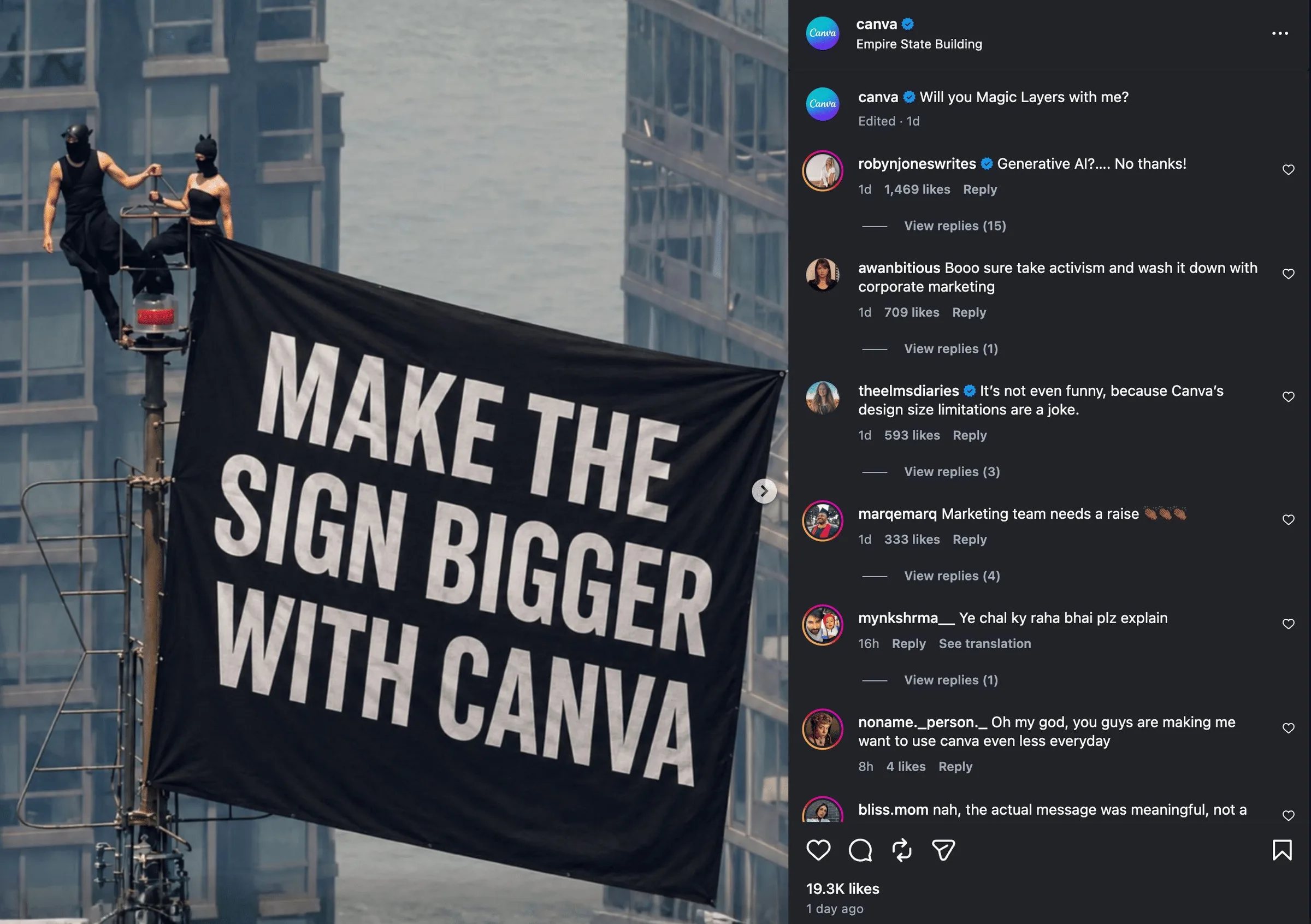
This is a genre now. A moment breaks, and within an afternoon a hundred social managers race to graft a logo onto it, not because they have anything to say, but because silence is a missed impression. The banner about the power of love became a template. The template became inventory. The speed is the tell. None of it required a shoot, a studio, or a single original thought, only a trending topic and a generative tool, and that frictionlessness is exactly why it never stops.
We saw the same thing when the Indian-American accountant Kumar went viral with their first Instagram post on KumarMethod.
The machine, in three moves
The Empire State Building proposal is a tidy diagram of how the attention economy metabolizes a moment. It runs in three moves, and all three now fit inside a single news cycle.
First, someone does something extreme enough to break through, in this case by risking their lives. Second, People clone, remix, and fabricate versions of it faster than the truth can get its boots on. Third, brands and toolmakers trendjack the whole mess before it cools, chasing the same attention.
Each stage feeds the next. The stunt exists because platforms reward extremity. The fakes exist because the stunt is trending. The ads exist because the fakes and the real thing together have become a place where eyeballs gather.
It is a closed loop, and it runs on one fuel, our attention, harvested and resold at every step. The couple lit the match. Everyone downstream poured on gasoline and called it engagement.
Why nobody comes out of this clean
It is tempting to pick a single villain, and the discourse obliged, cycling through the couple and then the brands that jumped on the bandwagon. The more uncomfortable truth is that the incentives implicate everyone in the chain, the audience included.
The climbers gambled their lives for reach and got it. The platforms took the most reckless thing in the feed and handed it the widest possible distribution, because recklessness performs. The AI companies turned it into a demo reel. The brands turned a woman clinging to an antenna into a dress ad. And the rest of us rewarded every layer of it, by watching, sharing, arguing, and yes, by reading and writing pieces exactly like this one.
That last part matters, and I am not going to pretend otherwise. A publication covering the phenomenon is still, mechanically, part of the phenomenon. The honest position is not to stand above the loop and tut. It is to admit that the loop is brutally efficient, that it caught all of us, and that understanding how it works is the only move that does not simply feed it a little more.
The bill nobody is pricing in
The costs are easy to wave off as the price of a fun week online, and they are not. Start with trust. When a real, dangerous, verified event is instantly surrounded by convincing fakes, those fakes do not only mislead people about themselves. They train everyone to disbelieve the real thing too, which is how you arrive at a world where genuine footage of anything can be shrugged off as “probably AI.” That is a slow corrosion, and it is speeding up.
Then there is the incentive we just reinforced in front of millions of impressionable people: that the surest route to relevance is to do something that could kill you, on camera, somewhere you are not allowed to be. Someone will chase that high and not survive it, and when they do not, the same machine will spin up tribute clips and a brand will find a tasteful way to mention its product. We are pricing none of this in. We are counting the likes.
Is it too late to fix this?
There's no fix that fits in a caption, and pretending there is would just be more content. But the honest version is simple: everything here happened too fast, and the cure is to make it slower.
The platforms could stop rewarding people for nearly dying on camera. A stunt that puts two lives on a spire should not be the thing the algorithm pushes hardest. The brands could learn to say nothing when they have nothing to add, which is most of the time. The AI companies could label what they generate, so a fake climb and a real one don't sit in the same feed with no way to tell them apart. And the rest of us could do the least glamorous thing of all: stop, and check whether something is true before we pass it on.
None of that is a clean solution, and the machine is bigger than any single one of them. But it starts with refusing the easy story. This was never a love story. It was a demonstration, from 1,400 feet up, of how little a real human moment is worth now.
The bottom line
So picture it one more time. Two people, impossibly high, genuinely in love or performing love or, most likely, both at once, and beneath them a system that couldn't tell the difference and had no reason to care.Within a day, the real climb, the fake climbs, the demo reels, the dress ads, the Duolingo owl, and the think-pieces about all of it had blurred into one feed, each just another thing to thumb past. By next week the proposal is gone from your timeline. The machine that swallowed it is still hungry, already waiting on whatever moves you next.
 UGC Ads
How to Make Lifelike AI UGC Ads in 2026?
AI can now generate a scroll-stopping creator video in the time it takes to write the script. Here is the exact workflow, the tools that earn their keep, and the small choices that separate an ad people watch from one they thumb past.
Kamran Arshad3 min Rankings
Best AI Image Generator in 2026
We gave the best AI image generators of 2026 the same nine prompts and scored every one on realism, anatomy, physics, reflections, spatial reasoning, multi-object consistency, long-range scene reasoning, typography, and cinematography.
Kamran Arshad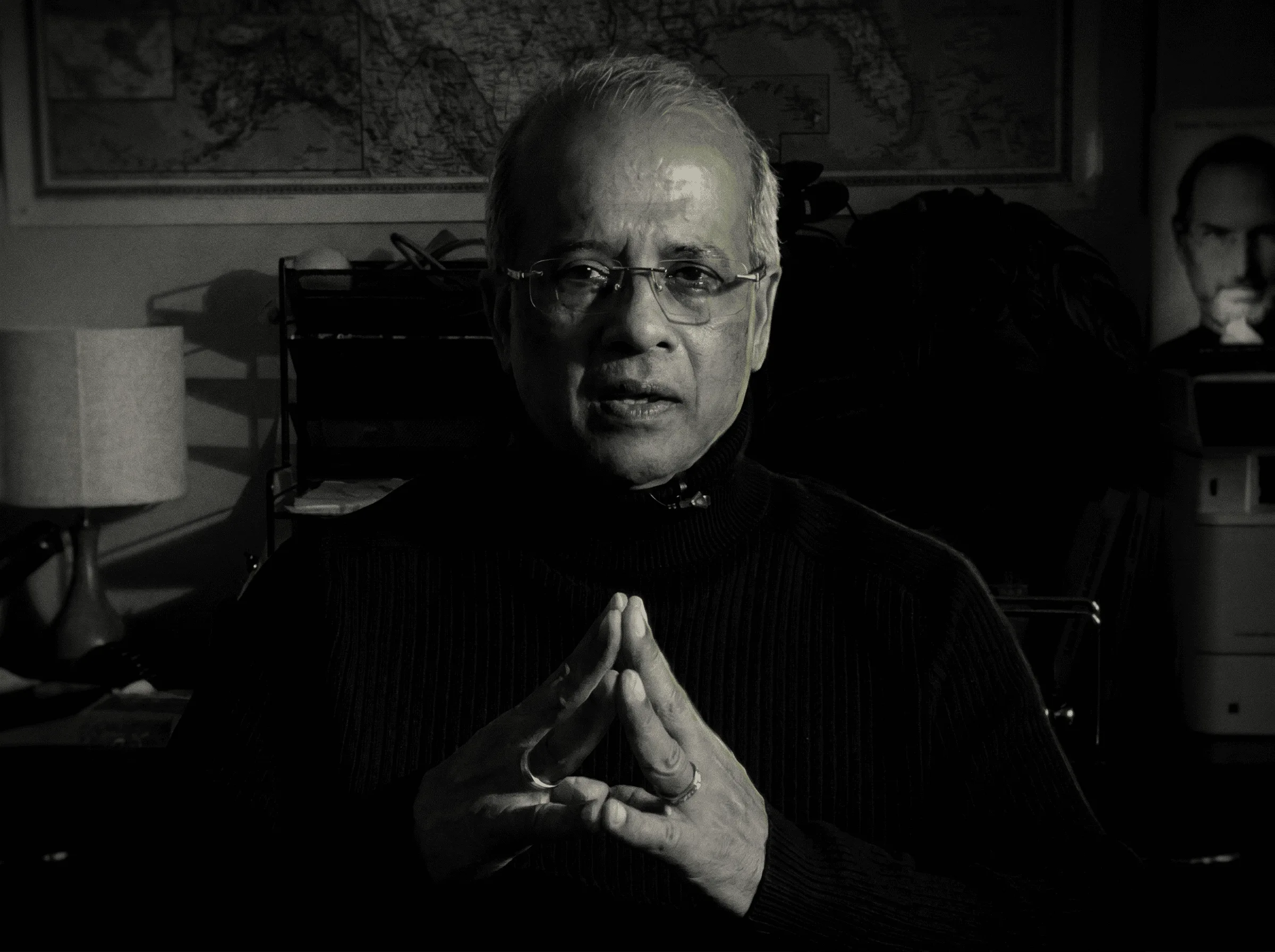 Virality
How to Make a Viral Kumar Method Reel With AI
In June 2026, a retired Indian accountant in a black turtleneck looked into a camera and said he was going to become the biggest accounting influencer in the world. Twenty million people watched. Within days he had nearly a million followers from a handful of posts, and the internet had a new template with a name: the Kumar Method.
Kamran Arshad
Read our flagship coverage first, in your inbox every Tuesday.
One piece. Five minutes. Sent directly. No roundups, no engagement bait.